Thursday, March 16, 2006

A Call for Freedom

Fire of Liberty

William Hague, the UK's Shadow(Conservative) Foreign Secretary, has a good Op/Ed in The Times that calls for the governments throughout Europe to call for the spread of democracy in Belarus. Here's a sample:
The Belarus opposition has a mountain to climb: unlike Ukraine, where both presidential candidates were on an equal footing, Mr Lukashenka is running as the incumbent and holds all the cards. Unlike Ukraine, the Belarusian opposition is not represented in parliament or in local government. The state-controlled system of counting votes is wide open to abuse and almost certain to be abused. The current inflated economic growth of Belarus may just be enough to choke democracy again. Those who try to justify the behaviour of the Lukashenka Government on the ground that some of its policies appear to be effective should remember that the record of applauding authoritarian regimes for their “efficiency” is not a happy one. Freedom of expression and the rule of law are not ideals to be sacrificed in return for the trains running on time.

If Mr Lukashenka is "“elected"” we will witness not just stagnant democracy, but democracy in reverse. When we can celebrate the flourishing of democracy in so many formerly communist states, we must not forget the people living in places where it is being stamped on. All of us who enjoy the right to free and fair elections should salute the activists and candidates who are now bravely battling on without freedom or fairness, and condemn a regime that adopts the language of democracy as it retreats into despotism.

It is time to offer support to the people of Belarus and take a harder line against a Government that is forfeiting its legitimacy; and it is certainly time for more European governments to say so.
Bravo Mr. Hague, we need more folks like you in Europe who are willing to stand up for freedom. The folks in Belarus will appreciate such efforts when the fires of freedom are eventually lit in Minsk.

Visiting Iraq

Fire of Liberty

Check out Max Boot's article in the Weekly Standard on his most recent trip to Iraq.

Wednesday, March 15, 2006

Ukraine 2 years after Orange Revolution

Fire of Liberty

Here's a good article by Howard LaFranchi in yesterday's Christian Science Monitor that gives a pretty good update on Ukraine's continued march towards democracy which was started during the Orange Revolution some two years ago. One individual that seems to be getting a hang on the transition is Ukraine's Interior Minister Yuriy Lutsenko. Take a look:
But he agrees that the public must be engaged, and says the best way he can help to encourage that as interior minister is by reforming the national police. "People are feeling more like they are safe at home and on the street, but they also feel they can... come to us and report problems or suggest things, so that means there is more trust."

Ukraine's first civilian interior minister, Lutsenko rattles off statistics to demonstrate how crime is down over the last year - and to underscore his drive to rid the national police of corruption. He has fired 2,500 police, while 1,200 ministry officials are facing criminal charges - ranging from bribery to fraud and kidnapping. The state has been losing billions of dollars a year to corruption, he says.

"I think we are succeeding in building a new image for the national police," he says. Yet a concern for image does not prompt him to shy away when asked about human trafficking, an issue that rates high with US officials and rights groups dealing with Ukraine. "We know there have been and are a great number of Ukrainian women and even children sold into sexual slavery," Lutsenko says.

But recent revelations of a case where police officers joined with criminal organizations to sell children from small border towns is prompting Ukrainians to act on the issue, as is a new ministry office focused on human trafficking, created last year at the US ambassador's recommendation.

Lutsenko says one key to addressing that problem will be getting tighter control of Ukraine's borders, something that requires cooperation from neighbors. To that end, he's hoping for a "trilateral" meeting in May of Ukraine, Russia, and the US.
While I'm no political expert, I have a strong feeling that Lutsenko's "Rudy Giuliani" stance and results with regards to crime and corruption will take him very far in Ukrainian politics.

Canada's Rebirth

Fire of Liberty

Peter Worthington has a good column in the Toronto Sun that notes how Canada's new PM Stephen Harper has demonstrated his undying respect towards the Canadian Armed Forces after years of disrespect from past Liberal party PM's like Jean Chretien and Paul Martin. I have to say that it's "Morning in Canada"(Remember Reagan's 1984 Campaign slogan "Morning in America" under knew the leadership of Harper

A Moderate voice on Islam from Eastern Europe

Fire of Liberty
While we see various clerics in Western European countries like the UK and Denmark calling for the imposition of Shari'a law or offering support to jihadis in the Middle East, their are other clerics from Eastern Europe who offer great voices of moderation. One individual that has expressed such a view is Mustafa Ceric, the chief Muslim scholar of Bosnia-Hercegovina. According to this piece by Stephen Schwartz, Ceric presented a Declaration of European Muslims that urged his fellow Muslims to make a better effort of interrgrating into European society and accept the fact that they need to accept their fellow citizen's right to live in peace beside their neighbor. Here's a look at what Schwartz had to say about Ceric's wise words:
Ceric defines Europe as "the house of contract" -- a place where differing religions have equal rights and protections. But Ceric calls European Muslims to "realize that freedom is not a gift given by anyone. Muslim freedom in Europe must be earned... Muslims who live in Europe should be more concerned now about their responsibilities than about their freedoms because by assuming their responsibility in European economic, political and cultural life, Muslims who live in Europe will earn their right to freedom... Muslims who live in Europe should present Islam to the western audience as a universal Weltanschauung, and not as a tribal, ethnic, or national culture."

Some elements of Ceric's Declaration may come under the fire of misunderstanding. The Bosnian cleric calls for recognition of Islam by European governments as one of the established religions, and for an opening to voluntary Islamic law in family matters. Bosnian Islam has followed the highly rational and adaptable Hanafi form of Islamic law, which is mainly concerned with purely spiritual matters and has accepted parity with Western secular law in numerous countries.

Instead of a clash of civilizations, a dialogue across borderlands could take place, with the historic eastern Mediterranean frontier of Croatia and Bosnia-Hercegovina serving as the point of mediation. Ceric's Declaration embodies an authentic, European Islam greatly influenced by Sufi spirituality. Since its circulation by the Center for Islamic Pluralism, the text has chiefly attracted support from foreign Muslims, including Turkish and Indonesian intellectuals, because most American Muslims -- even moderates -- are caught up in the noise surrounding the "cartoon jihad" and other media frenzies. But the intelligent actor in history is capable of predicting, rather than of merely reacting, to events. Will Ceric's offer of a solution to the problem of European Islam be considered before much more time is wasted?
European Muslims deserve to hear from more people like Ceric then the current lot of Wahhabi firebrands.

Are we running on Empty?

Fire of Liberty

Maybe the folks in academia, Hollywood and in the MSM should take a gander at Max Schulz's piece on oil over at TCS Daily before they keep on promoting their nutty Malthusian projections that we're about to drain Earth of its oil. According to Schulz, we shouldn't be fretting about running out of Uncle Jed's "Texas Tea," due to the advent of better technologies that allow us to explore and retrieve oil from older drill sites, find more oil fields as well as the ability to extract oil from things like oil sands (Canada) and Shell(Colorado). All in all, we'll never run out of sources of energy because man will always find alternatives or improve technology to meet our demands. I recommend you read the whole piece but here's a sample:
Almost since the first discoveries of oil in the U.S. in 1859, people have been saying we're running out. In 1874, the state geologist of the nation's leading oil producer, Pennsylvania, warned the U.S. had enough oil to last just four years. In 1914, the federal government said we had a ten-year supply. The government announced in 1940 that reserves would be depleted within a decade and a half. The Club of Rome made similar claims in the 1970s. President Carter famously predicted in 1977 that unless we made drastic cuts in our oil consumption, "Within ten years we would not be able to import enough oil — from any country, at any acceptable price." And so it goes today, where a slew of books and Web sites make fantastic claims about dwindling supplies of crude.

The chief problem with those who say the world is running out is that they have always looked at the issue the wrong way. Questions about energy supply shouldn't be thought of in terms of how much is available, but in terms of how good mankind is at finding and extracting it.
If you want to read more on this argument, I suggest you check out The Bottomless Well by the Manhattan Institute scholars Peter W. Huber and Mark P. Mills. Pretty good read.

A French Economic Oddity

Fire of Liberty

Jonah Goldberg has a good piece on why the French are having such great problems with their economy. Jonah notes that even when the government makes a move to jumpstart competition within the workforce by passing a law that allows employers to fire workers under the age of 26 who don't actually perform their job duties, they run into violent protest amongst the college crowds at France's major universities not to mention their fellow union brethren. It's amazing that the educated members of French society are so willing to keep their economy in a stupor just to keep their precious welfare state going but then again we are talking about the French. Anyway, I thought Jonah put it well when he noted:
In response to the hint of "flexibility," students at the Sorbonne rioted with the aid of France's powerful labor unions. Fifty-eight percent of French voters now believe the First Employment Contract should be repealed.

The Sorbonne takeover is the most interesting and revealing part of the story because these are the best students France has to offer. In other words, these kids should have the least trouble finding work. But they're revolting because they understand that France isn't an egalitarian society — French propaganda notwithstanding. It is a system designed to lavish job protections, perks and, most of all, the French "lifestyle" on the upper-middle class. France pretends to be a great civilization, but in reality it wants to be an Epcot Center attraction, a "FranceLand" where everything is comfortable and protected. Liberating the job market, even a tiny bit, threatens a system designed to keep the French upper crust from working too hard and to keep those brown-skinned and lower-class slobs out of the best jobs and cocktail parties.
Well said Jonah.

Fighting Mullahs with Oil

Fire of Liberty

Take a look at this from the Financial Times:
Japan, Iran'’s biggest oil customer, on Wednesday became the first country to reduce its imports of Iranian oil because of Tehran's nuclear dispute with the west.

Nippon Oil, Japan'’s largest refiner, will cut its purchases of Iranian crude oil by 15 per cent this year, Fumiaki Watari, Nippon'’s chairman, said on Wednesday.

"We have started reducing the percentage of Iranian crude and (are) shifting to other grades,"” he said in Tokyo. "“Risks related to the country are getting higher."
I have to say that if more nations and their respected oil refiners/importers around the world follow the lead of Nippon Oil(Japan's largest oil refinery), I think we could turn the mullahs away from their nuke quest. Unfortunately we're probably going to have to push the mullahs harder by supporting the democratic movement in Iran (Then we could kill two birds with one stone.)

French Styled Economics

Fire of Liberty

During the past few weeks, I've been writing pretty heavily on how our politicians in Washington D.C. are playing a dangerous game with our economy and allies with their continued talks and threats of nationalistic/protectionist legislation on TV and their respective wells on Capitol Hill. The reason why I do so is for the sake of the American people to have stable and well paying jobs so they can help themselves and stay away from the outstretched arms of government thus keeping this nation on a path to economic growth which makes the US economy second to none.

Now we could go down the path of economic isolationism much like we did in the late twenties (Anyone recall Smoot-Hawley tariff and the Great Depression)if you want but I'm guessing that when push comes to shove folks will prefer the current policies of the White House and Congress(At least for now) that promotes economic growth and job creation(Domestic and Foreign based)thus resulting in record low levels of unemployment which beats the current problems of high unemployment (10% nationally, 23% for 18-26 year olds and 50% in poor minority suburbs) and low economic growth that seems to be a common under France's "economic patriotism." What's so troubling about France's economic slumber is that its leaders refuse to see that these nationalistic policies are keeping their economy deflated.

In fact, French President Jacques Chirac had the nerve to announce in Germany yesterday that it was "absolutely absurd" if not crazy to suggest that France has made an even greater turn towards economic protectionism of late. Here's what Hugh Williamson and Tom Braithwaite had to report in the Financial Times on Chirac:
In comments set to raise the political temperature in Europe over moves by Spain, Poland and France to shield parts of their economies from foreign investors, Mr Chirac attacked critics in Germany and elsewhere of his government's industrial policy in recent months.

France received "twice as much foreign direct investment [FDI] as Germany", he said following a meeting in Berlin with Angela Merkel, German chancellor, adding that "something is wrong when France is accused of behaving in a protectionist way".

There has been widespread international criticism of intervention by the French government, notably in its attempts to block a potential takeover bid for Suez, the Franco-Belgian power group, by Enel, its Italian rival.

Michael Glos, German economics minister, last week condemned the "protectionist drift" in some European Union countries, while Thomas de Maizere, Ms Merkel's chief of staff, accused Paris of undermining EU rules and of trying unsuccessfully to "build walls" around its economy.

Figures from the Organisation for Economic Co-operation and Development suggested that on FDI Mr Chirac's point was correct. But economists said FDI could not be used to measure the openness of markets, pointing out that, for instance, China's protected market enjoyed a high level of inward investment.
I'm thinking that the folks out of a job in France are glad that Chirac is on his way out the door, I wish I could say the same about PM Dominique de Villepin and his "economic patriotism." Let's hope that the folks in the US promoting their own arcane version of such protectionist measures will take note of France's troubles and shy away from such rhetoric.

Tuesday, March 14, 2006

An Honest Look at Illegal Immigration

Fire of Liberty

National Review's editor Rich Lowry has a good syndicated column out today that points out that while folks(including President Bush) keep on going on about how illegal immigrants perform certain jobs that citizens in the US won't do, need to recheck their numbers. In fact until folks get this idea out of their heads and start accepting the economic realities within America we will still continue to have the problem of illegal aliens. Here's a sample of Lowry's work:
Take agriculture. Phillip Martin, an economist at the University of California, Davis, has demolished the argument that a crackdown on illegals would ruin it, or be a hardship to consumers. Most farming — livestock, grains, etc. — doesn't heavily rely on hired workers. Only about 20 percent of the farm sector does, chiefly those areas involving fresh fruit and vegetables.

The average "consumer unit" in the U.S. spends $7 a week on fresh fruit and vegetables, less than is spent on alcohol, according to Martin. On a $1 head of lettuce, the farm worker gets about 6 or 7 cents, roughly 1/15th of the retail price. Even a big run-up in the cost of labor can't hit the consumer very hard.

Martin recalls that the end of the bracero guest-worker program in the mid-1960s caused a one-year 40 percent wage increase for the United Farm Workers Union. A similar wage increase for legal farm workers today would work out to about a 10-dollar-a-year increase in the average family's bill for fruit and vegetables. Another thing happened with the end of the bracero program: The processed-tomato industry, which was heavily dependent on guest workers and was supposed to be devastated by their absence, learned how to mechanize and became more productive.

So the market will manage with fewer illegal aliens. In agriculture, Martin speculates that will mean technological innovation in some sectors (peaches), and perhaps a shifting to production abroad in others (strawberries). There is indeed a niche for low-skill labor in America. The question is simply whether it should be filled by illegal or temporary Mexicans workers, or instead by legal immigrants and Americans, who can command slightly higher wages. The guest-worker lobby prefers the former option.
Once we start enforcing the laws against illegal immigration and erasing the faulty notions about how these workers keep our economy going the better off we will be. I'm alright with immigration but I prefer the folks who came here to be legal.

Crunchy Con Americana

Fire of Liberty
Crunchy

If you want to learn a little more about the families that of today who have three or more children(The one's mentioned in Longman's piece) then I suggest you check out Rod Dreher's new book Crunchy Cons which is a book that points out that there's is indeed a subsection of America who are socially conservative but also have a nack for organic food and see the harmful affects that an overly excessive love for consumerism can have on a nation as a whole.(He's not advocating some socialist utopia but is just concerned that the folks who think about money all the time and want all the new toys generally hurt their relationship with friends and family). All in all Dreher shows that there is an movement amongst the American populous that wants to get closer to their family, community, and religion or what the late Russell Kirk(Great conservative mind) called the "first principles," . Now from what I've read so far, I can say that I generally agree with most of Dreher's ideas but I' m still a little wary about some of his ideas on economics, technology and food. I guess that's why conservatives like me and the folks in the conservative movement as a whole aren't in such a narrow mind-set like liberals and the MSM seem to portray us as. I'd say that we're much like a large family with its many quirky relatives but deep down inside we still believe in some basic things that making us conservative. While others might beg to differ with me about Dreher's Crunchy Cons, I see this as a good contribution to the conservative movement and suggest you go out and get a copy and discover for yourself.

For more on Crunchy Cons go to the Crunchy Con blog. Pretty good.

Demographics: The Lifeline of A Nation

Fire of Liberty
Phillip Longman, a fellow at the New American Foundation and author of The Empty Cradle, has a good piece in USA Today that points out that folks living on the coasts and considerably blue state regions of America are less likely to have children(one at most) while the folks in the heartland and red states are generally more inclined to have massive families (three or more kids) thus creating a situation in which America tends to be heading towards a more conservative hue. In fact Longman points out that this baby boom amongst the more conservative segments of America could set off another great cycle in history. Here's a sample of Longman's excellent Op/Ed:
What's the difference between Seattle and Salt Lake City? There are many differences, of course, but here's one you might not know. In Seattle, there are nearly 45% more dogs than children. In Salt Lake City, there are nearly 19% more kids than dogs.

This curious fact might at first seem trivial, but it reflects a much broader and little-noticed demographic trend that has deep implications for the future of global culture and politics. It's not that people in a progressive city such as Seattle are so much fonder of dogs than are people in a conservative city such as Salt Lake City. It's that progressives are so much less likely to have children.

It's a pattern found throughout the world, and it augers a far more conservative future -— one in which patriarchy and other traditional values make a comeback, if only by default. Childlessness and small families are increasingly the norm today among progressive secularists. As a consequence, an increasing share of all children born into the world are descended from a share of the population whose conservative values have led them to raise large families.

Today, fertility correlates strongly with a wide range of political, cultural and religious attitudes. In the USA, for example, 47% of people who attend church weekly say their ideal family size is three or more children. By contrast, 27% of those who seldom attend church want that many kids.

In Utah, where more than two-thirds of residents are members of The Church of Jesus Christ of Latter-day Saints, 92 children are born each year for every 1,000 women, the highest fertility rate in the nation. By contrast Vermont -— the first to embrace gay unions - has the nation's lowest rate, producing 51 children per 1,000 women.
For me, I'm glad that folks in America are busy keeping the birthrate high so we won't be seeing the demise of our country much like the Europeans are experiencing. I might beg to differ on a certain amount of Longman's take on the growth of America(With regards to religion and politics. He's a liberal but a good one.) but it's a good and thoughtful piece on demographics. I highly recommend you head over to Foreign Policy and read a much longer version of Longman USA Today Op/Ed. You might learn a thing or two. Also check out his book The Empty Cradle: How Falling Birthrates Threaten World Prosperity and What to Do About It as well as Ben Wattenberg's Fewer.

Fire of Liberty

Fire of Liberty
Iranandnukes

The above is my good friend Jason Crosby's take on Iran's attempt to join the nuke club. Pretty good if I say so myself. You can find more of his work at Ink Doodles.

Iran's Crackdown On Democracy

Fire of Liberty

While the news keeps on focusing about the happenings at the UN Security Council on how to stop Iran's quest for nukes few people are noticing that the mullahs have been cracking down on pro-democracy groups and individuals within Tehran. According to this article by Eli Lake in the New York Sun, the mullahs have been gathering up activists throughout Iran who they suspect to have connections with the West or are being taught on how to take on totalitarian regimes. One individual who the mullahs have targeted was Ali Afsahi, a former film critic and journalist, who was arrested in Dubai on February 13, 2006 by Iran's Ministry of Intelligence and Security after he had attended a workshop on Human Rights and another seminar with the International Center for Nonviolent Center(Which had folks who helped overthrow Milosevic in 2000 providing advice on Nonviolent activism in a dictatorial regime).

When a regime starts arresting and beating activists who attend seminars on non-violence or democracy you know that the folks must be gaining some headway with the folks in the street especially after the US has pledged some $75 million to help the true democratic movement within Iran. Other observers have noted that this most recent arrest of an Iranian citizen on the soil of another sovereign nation like the UAE is to present a large blinking neon sign to the pro-democracy movement within Iran that this is what will happen to them if you try to attend any more conferences like these again. Now the regime might think that this tactic will have some staying power in scaring off human rights activists from learning more about promoting democracy but I'm betting on history(The Soviets did the same thing during the Cold War and we saw what happened.) and the people of Iran's desire for freedom will be much stronger in the long run. After reading the following from the article, I'm even more convinced that the folks fighting for freedom will prevail. Take a look:
The president of the International Center for Nonviolent Conflict, Peter Ackerman, said the regime in Tehran was persecuting a man for receiving readily available information. "We are in the business of exchanging information about the nature of nonviolent conflict," he said. "We give no specific advice on what they should do or plan in their specific conflict, and we provide no resources except educational resources to opposition groups. We facilitate workshops based on requests from people suffering under oppression."

Mr. Ackerman helped produce "Bringing Down a Dictator," a documentary that featured the inside story of the Serb opposition, Otpor, and its strategy for organizing protests against Milosevic's efforts to steal the September 2000 presidential election, which led to his removal from power.

Mr. Ackerman, like Otpor, are adherents of the theory of Gene Sharp, the author of a series of books on nonviolent conflict who is generally credited with being the first person to study rigorously the techniques of mass civil disobedience and place them in the context of traditional military strategy. In 2004, Cuban dissidents were arrested in Havana for possessing video tapes of the documentary.

One of the Otpor trainers at last April's workshop in Dubai, Ivan Marovic, described his work as follows: "The content of the workshop consisted of explaining the principles of mobilizing the population in the situation where fear is high and there are tensions in the society, meaning they are facing a political crisis.

"We discussed how to overcome that crisis without destruction of property and loss of human life. These are nonviolent strategies of civic mobilization. This is a standard workshop based on the examples from Otpor, our fight against Slobodan Milosevic."

Mr. Marovic sees some similarities between the plight of Mr. Asfahi and many of his comrades from the Milosevic era. "This whole thing is nothing new. In Serbia we were accused of being terrorists and mercenaries of the west. This just shows the nervousness of the regime in Iran."
Yes, I'd say the mullahs are running for the hills with regards to the pressure that the West is applying on them with regards to the nukes that they're going after the people one thing the can go after which is the Iranian people and groups who are mearley seeking freedom from their masters. In fact, I think the US could find a way to place sanctions on Iran not only for its quest for nukes but also for its gross violations of human rights. It might be too much on the Chinese(Doesn't have a great record with regards to human rights) and the UN to push this but it would be worth a try and might be the best thing to do. Anyway, here's hoping the Iranian democracy activists and the UN Security Council best of luck in taking on the mullahs.

Duff Beer in Kitchen Faucet

Fire of Liberty

Now here's the kind of plumbing work that Homer J. Simpson and Norm from Cheers would love to have in their house.

Foreign Investment: It's a good thing.

Fire of Liberty


Here's another example of another foreign investors providing some much need jobs to the folks of the US that wan't be possible if some Congressmen push through nationalistic/protectionist legislation. I for one don't want our economy to fall into the dregs much like the French economy has of late via their abysmal "economic patriotism."

A British Army Legend

Fire of Liberty
As I was doing through my daily browsing of the news and the various blogs, I came across a post by Iain Murray over at National Review's the Corner that noted the passing of the UK's General Sir Anthony Farrar-Hockley. As Murray notes, Sir Anthony was a decorated hero of the Korean War after demonstrating his courage under fire and his ability to keep his men focused on holding their position against a ten hour assault from the Chinese. Though he would win a Distinguished Service Order, Sir Anthony wouldn't receive this honor for many years to come due to the fact the Chinese took him prisoner throughout the war. As with most soldiers, Sir Anthony made it his utmost priority to give his captors as much hell as he could thus resisting their attempts to brainwash him. He also made some six harrowing escape attempts thus aggravating his captors and bringing on countless hours or even days of torture at the hands of the Chinese and North Koreans. While most men would break under such pressure, Sir Anthony would continue his battle against his jailer and would eventually be released in 1953 with the conclusion of the war(Well for the UK part - South Korea and North Korea never signed peace treaty and still considered in a state of war but enough on technicalities)thus allowing him to further his career in the military. Here's what the Daily Telegraph had to say about Sir Antony's post Korean War journey in the British Army:
After serving in Palestine, Farrar-Hockley returned to the Glosters and went with them to Korea. Following his release from prisoner-of-war camp, he attended Staff College before rejoining the Airborne Forces, serving as deputy assistant adjutant and quartermaster-general, then as brigade major of the 16th Parachute Brigade. He saw active service during this period in the EOKA campaign in Cyprus, the landings at Port Said in 1956 and the British intervention in Jordan in 1958.

The following year he became chief instructor at the Royal Military Academy, Sandhurst, before taking command of the 3rd Battalion Parachute Regiment in the Persian Gulf in 1962. The greatest feat of arms of his career was, perhaps, his battalion's capture, in 1964, of the Arab Nationalist stronghold at Wadi Dhubsan deep in the Radfan mountains north of Aden.

The battalion was called upon to undertake a difficult 10-mile advance into mountainous enemy territory and then attack a highly inaccessible and strongly-defended rebel base. Helicopters were not available in sufficient numbers to permit an assault from the air, so his men roped themselves down the sheer sides of the flanking ridges and achieved complete surprise over the rebels in the gorge below.

During a hard-fought battle, Farrar-Hockley's Scout helicopter was shot down beyond his own lines. With some difficulty, he rejoined his battalion and, finding it pinned down, he launched a well-executed attack which drove the enemy from their position. This action led to the submission of the dissident Radfani tribes and to the award of a Bar to Farrar-Hockley's DSO.

After relinquishing command of his battalion in 1965, Farrar-Hockley went to the Far East to be Chief of Staff to the Director of Operations in Borneo, where he helped to organise secret operations inside Indonesian territory which brought about the end of President Sukarno's "Confrontation" with Malaysia.
I can assure you that we've probably have a lot of our servicemen fighting for our freedoms that have a lot of similarities to General Sir Anthony Farrar-Hockley. For the rest of General Sir Anthony Farrar-Hockley career and life see here and here.
---------------

Also, Sir Anthony was a pretty good historian with regards to the Korean War. Now for those who want to know more about the Korean War, I recommend that you look at his books The Edge of the Sword(1954), A Distant Obligation (1990), An Honourable Discharge(1995).

2008 Crystal Ball

Fire of Liberty

If you watch any political show or read some news/opinion magazine you've probably under the impression that Hillary and McCain are the presumed front runners for president come 2008, well it seems that Pejman Yousefzadeh over at TCS Daily begs to differ. Here's a look:
The last Presidential candidate to have ascended to the Oval Office from any chamber of Congress was John F. Kennedy in 1960, when he moved to the Presidency from the Senate. Since then, the American electorate has elected, in order, a sitting President of the United States (1964), a former Vice President (1968), a sitting President (1972), a former Governor (1976), a former Governor (1980), a sitting President (1984), a sitting Vice President (1988), a Governor (1992), a sitting President (1996), a Governor (2000) and a sitting President (2004). Along the way, four Senators (Goldwater in 1964, McGovern in 1972, Dole in 1996 and Kerry in 2004) have been defeated in their quests for the Presidency as nominees of their party.

What all of this would appear to indicate is that America is an executive culture and not a parliamentary one. We appreciate Governors, Vice President and incumbent Presidents — all of whom have executive experience to bring to bear in performing their duties as Leader of the Free World. In contrast, Senators and Representatives cast votes. To be sure, casting votes is an important activity and oftentimes requires no small amount of courage. But a legislator is not an executive and it is easier for an executive to make claims about leadership experience that will stick positively with the public than it is for legislators — — as recent election cycles have shown.
One area he didn't mention was the fact that with the election two years people could grow tired of the two media darlings and will find it real easy to select some other person at the voting booth with a better set of ideas and direction. No matter what, thpresumeded front runners will also face a horrific run through the primargauntletet where a lot of folks in America's would rather vote for a loser than pick the likes of Hillary Clinton and John McCain to be their next nominee. Also don't count out the possibility for a Dark Horse candidates like Rutherford B. Hayes in 1876 or Bill Clinton in 1992 coming out of nowhere to take it all away from the heavy hitters come nomination time. I'm betting we could see the same thing happening come 2008.

Monday, March 13, 2006

Protectionist Rhetoric Hurts American Workers

Fire of Liberty

As I think about the nationalistic/protectionistic spirit that seems to be running through certain segments of Congress and in the Jacksonian leanings amongst the US populous, I can't help myself in pointing out that the "foreign" investors that these folks rally against are actually bringing jobs and money to our shores. While I can name a cornucopia of foreign owned firms that provide well paying jobs to a large subsection of the American people, I thought I'd set my focus on Toyota. If you go here over at Toyota's website, you'll discover that the maker of the ever popular Camry and Prius provides some 33,113 well paid jobs and brings in some $14.1 billion dollars of investment to the US not to mention some $26 billion that's spent on parts, materials, goods and services throughout North America (Didn't have individual breakdown amongst Mexico, Canada and the US) thus providing even more jobs and money for more US citizens. What's even more interesting is that Toyota just announced today that they're planning to expand their production of Camrys by another 100,000 by 2007 and thus adding some 1,000 more jobs to the US economy. Now some Congressmen and Senators will continue to push their nationalistic/protectionistic agenda to please the public or domestic manufactures (In Toyota's case Ford, GM and Dodge) if they will but I'm betting the Toyota workers throughout the US and the folks of Indiana who will get these future jobs are thankful for these "foreigners." I'd also like to add that since 1991 Toyota has also provided some $310 million in philathropic donations to the US thus providing yet another reason to be grateful for a foreign nation who helps our people out in more ways than one.

Let's just hope that these politicians get off their current protectionist high horse and realize that without foreign investment and industries in the US, Americans would be out of a job.

Stalin's Folly

Fire of Liberty
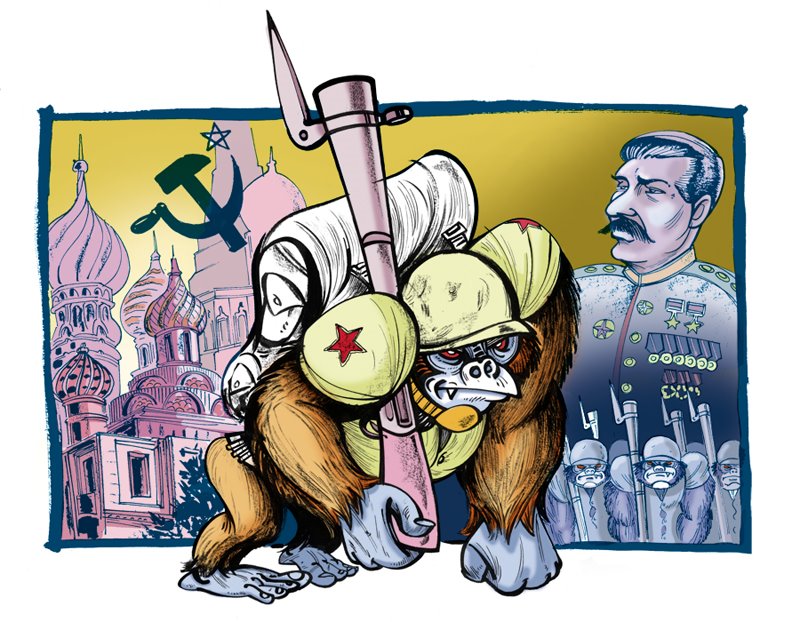
Iamapeman

Here's my friend Jason Crosby's take on an article on how Stalin'sinstructed his team of scientists to create a half-man, half ape, Soviet super-warrior that would be "....a new invincible human being, insensitive to pain, resistant and indifferent about the quality of food they eat." Thankfully the world through the tides of history, simple biology, and G-d were sparred from the evil scourge of Stalin. When you have a man who was famous for saying "The death of one man is a tragedy. The death of a million men - that is statistics." and the killing of 30 million or more of his own people you know my sense of relief. Enjoy the fine illustration and visit Jason's blog Ink Doodles.

Baseball on Juice

Fire of Liberty
Now I'm going off the political/democracy promoting reservation of Fire of Liberty to focus on my least favorite sport, which is Baseball.(Football is my sport). The main reason I'm doing this is that my good friend Jason Crosby has been running a little commentary on his blog Midwest Ramblings about Barry Bonds and his cravings for steroids. I for one pretty much agree with Jason with regards to his disgust with Bonds popping pills, taking creams or drinking steroid filled shakes just to wack the hell out of a baseball because he wanted to be the HR king and raise his stature. For me he just sullies the sport and makes today's athletes look like wimps compared to giants like Babe Ruth (He ate & drank tons of beer and food, probably didn't hit the gym), Ty Cobb (Drank like a fish), Mickey Mantle (partied and drank), Ted Williams, Roberto Clemente, Willie Mays and Hank Aaron who got out there and did all they did without the help of steroids or supplements. I for one like the fact that idiots like Bonds, McGuire and Palmerio are being tarred and feathered all over the sports shows and pages because I think you can shame them enough that you'll cause a grassroots revival amongst America's young ballplayers and their parents(I'm not including the real nutty ball crazy parents- you know who you are) for great ideas like hard work, pride, fiscal fitness ,and the love of the game. If they hear more about the greats of Baseball's yesteryear who achieved all these great things without the aid of steroids you'll also see the pros of today getting as far away from Bonds favored substances and return to the natural training thus saving a sport for youngsters to admire in the future.

Now aside from this act of shaming, MLB should apply the dreaded asterisk by the baseball players record and put fines other measures within the MLB rules that put the fear of G-d in the players who go down the steroid road. (Hall of Fame bans or cash. Nothing scares them more than fame and money.) In fact columnist George Will pretty much said the same thing as I did in his most recent column (Better written than what I can say.) Check it out:
It is still unclear if there will be judicially imposed punishment in this matter. But condign punishment for a man as proud as Bonds would be administered by the court of public opinion, and exclusion from the Hall of Fame.

In any case, Bonds' records must remain part of baseball's history. His hits happened. Erase them and there will be discrepancies in baseball's bookkeeping about the records of the pitchers who gave them up. George Orwell said that in totalitarian societies, yesterday's weather could be changed by decree. Baseball, indeed America, is not like that.

Besides, the people who care about the record book -- serious fans -- will know how to read it. That may be Bonds' biggest worry.
Shame is the answer, but then again how shameful can you get to sink so low to take the juice in the first place. For me this is why I'll stick to the NFL and College Football.(It's more fun to see their scandals because it involves chicks and the idiot boosters.)

Steward of GOP First Principles

Fire of Liberty

Now here's an example of a Republican member of the Senate who seems to understand how important it is to right the course of the GOP and return it to the economic and political principles of Coolidge and Reagan. I just hope more in the GOP do the same.

GOP Course Correction

Fire of Liberty

Robert Novak has a good column out today that notes that while Republicans found time to go before the TV cameras and released a torrent of attacks against the Dubai Ports World's deal but couldn't find time to do the people's(The one's who put the Republicans in their lofty leadership post)business which is to pass an actual budget that at least tries to exhibits a modicum of fiscal restraint. Now I'll admit that they're some Republican Senators(Tom Coburn, John McCain) and Congressmen(Mike Pence(R-ID), Shadegg(AZ) up on Capitol Hill fighting to cut out wasteful spending from our national budget to reduce our deficits and keep us on pace to cut the deficit in half by 2009 but these crusaders for fiscal restraint seem to keep running into a countless number of politicians like Sen. Susan Collins(R-ME) (who bemoans tax cuts as being too expensive) who isn't compelled to reduce or eliminate some or all of the $29.4 million in pork-barrel earmarks bound but for her state of Maine or the call for a $16.3 million for home heating subsidies.(Wants both cake and ice cream- but never just one) Now I know that Collins is perfectly safe from this backlash in the deep blue woods of Maine because she brings in the bacon not to mention that the GOP needs her votes to retain control of the Senate but as for the rest of the Republicans in America, I can tell you that if the GOP doesn't return to small government and fiscal conservatism(Not through rhetoric but through actions now) that's been a a mainstay with Republicans from Coolidge, Goldwater, Reagan and Gingrich then they will see some of their base stay home which could result in tears in 06 or 08. So if anyone in D.C. reads this blog (Well, I can wish can't I) then they should take note what the folks in America are feeling. So get to chopping at the budget and keep those taxes low or you might see a slow decline in your power-standings come the day after the 06 election.

Friday, March 10, 2006

Economic Killer

Fire of Liberty

Irwin M. Stelzer of the Hudson Institute has a good piece over at the Weekly Standard that points out that the while the protectionist crowd is just revving up its engines within the halls of Congress, these forces are in full swing throughout Europe and is putting a severe dent in free trade and the world economy. See for yourself:
Until now attempts to throttle free trade were largely confined to goods, services, and people. Now politicians the world over are moving to prevent capital from crossing borders. No surprise, France is leading the way, proposing to insulate eleven sectors of its economy from foreign takeovers. President Jacques Chirac and prime minister Dominique de Villepin want to make especially certain that French energy companies are not taken over by foreigners as the European industry consolidates in anticipation of impending deregulation. So they brokered a merger of two French energy companies, Gaz de France and Suez SA, to fend off a possible takeover of Suez by Italy's largest power company, Enel. Although French President Jacques Chirac told Italian Prime Minister Silvio Burlesconi that he viewed Enel's plans as "hostile," the French deny violating the law and spirit of the EU common market by interfering in the transaction. Burlesconi, who did not intervene when Italy's second largest power company was taken over by Electricité de France, or when Banca Nazionale del Lavoro was acquired by France's BNP Paribasto, professes himself shocked, shocked at the French action. And European Commission president José Manuel Barrorso railed against "nationalistic rhetoric" of the sort France so vigorously opposed when pushing tighter European integration.

French antipathy to an invasion of foreign capital extends beyond its own borders. The government is adamantly opposed to the hostile bid of India's Mittal for Luxembourg's steel maker, Arcelor--itself the product of a merger of French, Belgian, Luxembourg, and Spanish steel companies. Thierry Breton, France's finance minister, claims that Arcelor's large workforce in France makes his government a "stakeholder," entitled to review everything from Mittal's plans for R&D spending to its social behavior.

Meanwhile, although Spanish companies have been on a worldwide takeover binge, when German power company Eon launched a $35 billion hostile bid for Spanish utility Endesa, the Spanish government announced that it "Will do everything in its power to ensure that Spain's energy companies remain Spanish." Trade and industry minister José Montilla is leading the charge to have the home-town favorite, Gas Natural, a company half Endesa' size, mount a competing bid.

Poland, too, is defying the European Commission by blocking Italian bank UniCredit's bid for local Bank BPH. And its former masters in the Kremlin are declaring 39 "strategic sectors" off limits to foreign control.

Here in America, politicians, led by Hillary Rodham Clinton, are in full cry against the takeover of P&O by Dubai Ports World, and are preparing to attack the planned takeover of UK-based Doncaster by another Dubai-based company--Doncaster's plants in Georgia and Connecticut manufacture components for military equipment.
I just hope we avoid venturing into the murky protectionistic waters that folks like Sens. Clinton and Schumer are pushing or we could end up economically stagnant much like the French and other European nations. Hillary might want to rethink this come 08.

Security Threatened by Protectionistic Leanings

Fire of Liberty
The Wall Street Journal has a good editorial(Free at OpinionJournal- registration required) out today on Dubai Ports World decision to sale off its North American ports to stave off the protectionistic rhetoric that has erupted in D.C. Just read what the folks in the "House that Bob Bartley Built," had to say about this whole fiasco:
Going well beyond Dubai, House Armed Services Chairman Duncan Hunter (R., Calif.) says he wants Congressional oversight of all foreign purchases of "critical infrastructure." Mull over that one for a minute. If you think corruption on Capitol Hill is bad now, wait until foreigners need approval from Congress for every multi-billion-dollar investment. The current investment review process was designed by the Reagan Administration to be discreet, and to keep Congress out, precisely to avoid such politicization.

In recent weeks Members of Congress have suggested that the foreign-ownership ban should apply to: roads, telecommunications, airlines, broadcasting, shipping, technology firms, water facilities, buildings, real estate, and even U.S. Treasury securities. If this keeps up, we'll soon arrive at France, where even food and music are "protected" from foreign influences as a matter of national survival.

The larger truth is that the flow of foreign investment into the U.S. is a sign of economic strength, not weakness. For 25 years pro-growth economic policies including monetary stability, steep tax-rate reductions on capital and freer trade have created a giant in-sucking sound of some $4 trillion of global investment into America. Economist David Malpass of Bear Stearns recently calculated that U.S. GDP grew by 100% between 1992 and 2005 while world GDP growth measured in dollars grew by only 70%. Over that same period, the U.S. created four times the number of new jobs as Europe and Japan combined.
Now the board says that hopefully this fuss about the ports was just one of those quirky "hallucinations" that happens from time to time but I'm betting its a calm before an enormous protectonistic storm due to the fact that a lot of the folks in Congress like Duncan Hunter and Chuck Schumer keep on yammering about keeping things "American" or preventing foreign entities from owning US entities. Even worse I think that such protectionistic rhetoric and actual legislation could launch the American economy into a tailspin because putting barriers up against foreign ownership/investment/participation within the US economy might convince these countries/businesses to take their massive sums of money out of our economy and put it elsewhere like China(They might be Red but the Chinese welcome venture capitalists from all over the place). Like I said before, it's alright to want nationally based companies to prosper and remain "King of the Hill" but when folks start suggesting legislation that would harm the dynamism of the US economy(protectionism eventually makes you soft by eliminating competition from other players, just look at has occurred France and Spain of late)and stray away from your core principles of free market capitalism and limited government just to assuage the "Jacksonian" impulses of America and ensure their political future they've gone too far. Thankfully folks like John McCain and President Bush seem to have still retained some of the same principles and core beliefs(McCain seems to be regaining his limited government/free market legs after his campaign finance reform days- He needs the GOP faithful for his 2008 run.) that they came to D.C. with many years ago, lets hope others in the nation's capital return to this view pretty soon. No matter what, a strong and dynamic economy is probably the greatest form of security that we can have (More money to spend on National Defense and Homeland Security).

Thursday, March 09, 2006

Populism Overload

Fire of Liberty

Jonah Goldberg has a great column in today's LA Times about how the current turn towards protectionistic populism with regards to issues like free trade and the most recent dust-up of Dubai Ports World will result in a devastating decline in our economic fortunes rather than enhancing it. Take a look:
Liberals are naturally sympathetic to socialistic arguments, conservatives to nationalistic ones. But to everyone's benefit these two outlooks have been quarantined in different parties. Conservatives have been culturally nationalistic but economically liberal (in the classical sense). Liberals have been economically nationalistic — on healthcare, regulation, taxes, unions — but culturally liberal. Although it's been quite painful for them, this cultural liberalism has kept the Democratic Party in favor of free trade and immigration. Protectionism hurts foreigners and poor Americans, after all.

Indeed, to be fair, the Democratic Party has been heroic in bucking its base — the economically nationalistic labor movement — on free trade. FDR, Truman and Kennedy were all consummate economic nationalists. Free trade was tactically in their interests for a long time because it dovetailed with labor's interest. When the United States stopped being the manufacturer to the world, the Democratic Party struggled — not always successfully — to stay pro-trade on principle, even at the cost of votes. Meanwhile, the GOP has had the opposite challenge: to stay pro-free trade even as its ranks swell with working-class voters enamored with their paychecks, not Adam Smith.

Now, a win-at-all-costs Democratic Party has realized that this is the perfect moment for it to re-brand all of its economic ideas in the language of patriotism. Many Republicans are determined to fight the Democrats for this turf. So they too are bending their economic policies to fit their cultural conservatism.
I for one hope that the Republicans would read some economics books or at least follow the economics of Ronald Reagan and get away from the rabble-rousing "beat the Democrats to the punch" nonsense that they're currently partaking in. But the politicians love their polls and prefer getting re-elected than standing on the principles they were originally elected on.

Could Blue Jeans Revolution prevail in Belarus?

Fire of Liberty

Well it seems that President Lukashenko of Belarus hasn't had a chance to read Francis Fukayama's The End of History and the Last Man or he'd know that the era of a Soviet Styled dictatorship went out long ago but then again what dictator in the style of Lukashenko is ever willing to actually allow the people to push him out of power after some twelve years of iron rule. From the looks of this article in The Times, the old school dictator has decided to pull out all stops once again to prevent his political opponents from ending his nostalgia for the Soviet dictatorship of yesteryear. You know Lukashenko means business when you read paragraphs like these:
Belarussian officials insist that the election will be free and fair. In the past year, though, the authorities have closed dozens of newspapers and pro-democracy groups and repeatedly jailed and fined opposition supporters.

Last week security agents beat up another opposition candidate, Alexander Kozulin. The shooting incident occurred when Mr Radevil tried to collect a camera used to take pictures of security agents assaulting Mr Kozulin's supporters.

When he went to the prosecutor's office to complain he was charged with threatening a police officer. It is still unclear who fired the gun but he is widely rumoured to have been a senior member of the elite anti-terrorism unit, Almaz.

The mere mention of Almaz sends a shiver down Svetlana Zavadskaya'’s spine. Her husband, Dmitry, is one of several prominent critics of Mr Lukashenko who have "disappeared"” in the past five years. She says that she will still take part in the protest on March 19 but she fears the worst. "“Bloodshed is quite possible,"” she said.
I just hope the opposition can bring about a change in power in this last enclave of Soviet style rule in Eastern Europe. Hopefully the continued condemnation of the current leadership in Minsk by President Bush and Secretary Rice will provide some needed support to the "true democrats" of Belarus. After twelve years of misrule, they deserve something.

Consequences from Port Breakthrough

Fire of Liberty

As I noted in an earlier post, I was a little concerned that DPW ceding to the populist whims and thus opening the door for future protectionist legislation, well it seems that their might be an even larger problem with such a turn around which is presenting a image of weakness within the White House. According to this story in today's Financial Times, it seems that the owners of DPW(Who happen to be the leaders in the Emirate of Dubai) chose to offer this divestiture or outright sale to another entity because they feel that President Bush has lost control of his party and command of the agenda due to his inability to get the deal through. Now I hope that this is mere speculation on the part of the Financial Times but if there is a growing consensus within the UAE and other US allies within parts of the Middle East, it could cause deep disruptions in our efforts to push forward or get our allies to push forward in our War on Terror in the region. I just hope that things haven't gotten this bad yet. We'll see.

North Korean Games

Fire of Liberty

It looks like the North Koreans are up to their same ole' dangerous games once again with the test firing of some new missiles. This is the main reason that the North Korean governments need to be slapped with more sanctions(Every time we or others send food, medicine and oil to the Hermit Kingdom it goes to the military and apparatchiks rather than the starving people) and greater condemnation from the US rather than talks that result in Pyongyang breaking its word over and over again.

Ports Breakthrough?

Fire of Liberty
As I watched the discussions on the whole port deal on MSNBC's Hardball and Fox News's Special Report with Brit Hume I see that the protectionistic forces within the US government seem to be prevailing in their efforts to block the current transfer of the six US ports from the British owned P&O to the UAE controlled Dubai Ports World. You pretty much know that things are going south when the House Appropriations Committee votes 62-2 to put the kibosh on the whole deal and both chambers are threatening to make their decision veto proof by including the legislation in a appropriation bill for Afghanistan, Iraq and Katrina relief. With all of this going on, no wonder the folks of Dubai Ports World has decided to divest themselves or sell the US ports to some other buyer. Just look at what the Financial Times had to report on the company recent move:
Edward Bilkey, the company'’s chief operating officer, said in a statement: "Because of the strong relationship between the UAE and the US and to preserve that relationship...DP World will transfer fully the US operation of P&O Ports North America Inc. to a US entity."” He said the decision was made by Sheikh Mohammed Bin Rashid Al Maktoum, prime minister of the UAE and ruler of the emirate of Dubai.

The statement was read in the US Senate by John Warner, Republican chairman of the armed services committee, who helped broker the compromise.

DP World, which had insisted it would maintain control of the US ports, made the move after finalising its $6.8bn takeover of Britain'’s P&O on Thursday.

The US ports facilities were only a small portion of P&O'’s global holdings but their acquisition by an Arab company sparked a storm of protest from lawmakers who said it could endanger US security.
Hopefully this decision by DPW will stave off any protectionistic leanings that are so prevalent within the halls of Congress today but if I know the folks pushing such ideas I know they'll be encouraged to come out even stronger if another deal like this emerges anytime soon.

Wednesday, March 08, 2006

Taking on the Culture of Death

Fire of Liberty

Over at First Things' blog On the Square, Joseph Bottom has a good post that notes that the whole subject of Euthanasia seems to be resurfacing within the national conversation of late with the continued drip, drip, drip of news stories of this vile act. As an individual who is physically disabled due to the degenerative nature of Muscular Dystrophy, I'm one who will jump up and down (well you get the point) to keep doctors or others from ending the life of folks because they see themselves and others a unfit to live, a burden, don't like their cleft palette (Look at the UK), claim they're just a "vegetable" or some other reason that seems to come right out of one of those late 19th, early 20th century eugenics book. Though my argument on this terrible "death culture" might seem simplistic or too emotional but it is a voice of many who feel that life is such a precious thing and shouldn't be sullied by folks who are so quick to prescribe or advocate a position of snuffing out a life. I'd have to say that Bottom puts the whole issue and the ever growing euthanasia movement (luckily there's anti groups as well) in greater detail with the following comments:
In the years since, it'’s risen and fallen, though even in the case of Terri Schiavo, never quite attaining the public visibility it reached in 1997. Maybe some reaction against the attempt to save Schiavo was inevitable, but if you watch as the news cycles roll past, you can see it building again here and there.

Wesley J. Smith has been relentlessly collecting these stories, and you can discern their pattern on his blog, Secondhand Smoke. Much of the latest news comes from Europe: Doctors in England want to terminate a child with spinal muscular atrophy, despite the parents'’ desire to care for him, while Holland has recently begun to allow euthanizing of babies, and euthanasia deaths are on a rapid rise in Belgium.

But here and there, you can feel euthanasia sliding back into public debate here in the United States, as well. When, in January, the Supreme Court ruled against federal sanctions against doctors in Oregon'’s euthanasia program, the media reports generally signaled that the issue would be coming back. The American Medical Association'’s latest "“Declaration of Professional Responsibility"” has replaced crucial protections and made easy a doctor'’s participation in euthanasia.

At some point in the next few years, I expect, we will see another solid, national push for legalized euthanasia and physician-assisted suicide. Some poster child will be selected——a sort of counter-Terri Schiavo——and the better-off-dead crowd will get into full swing. I don't think it will come quite as close to success as it came in 1997, but it may. Still, the Supreme Court'’s refusal to establish a right to euthanasia in Washington v. Gluckberg leaves the matter in the political realm, where the tides really do rise and fall.

There'’s a model here for what might have happened with abortion. I wonder how far the abortion advocates would have advanced, beyond the point where euthanasia is now, if Roe had not been imposed on the nation.
Now its very scary that folks would get up in the morning to support something the Nazis used throughout their tenure in Germany but thankfully you have folks like Joseph Bottom, Wesley J. Smith, and Ramesh Ponurru out there battling against this culture of death. As for me I'll continue to man my post in this fight and remind folks they should hold back on complaining about how tough their life or the life of their family member because all they have to do is look at someone else around the corner or in the next town whose life is much more diffucult and be lucky they're alive. You just have to play with the hand you're dealt.

To Much Agenda not Enough Facts

Fire of Liberty

Thomas Sowell has a wonderful column over at Townhall.com that points out that the current nine justices sitting on the bench of the US Supreme Court seem to a least have a working understanding of the principles of supply-and demand with its most recent rejection of the 9th Court Of Appeals ruling that oil companies were working together to set gas prices at high levels. Check it out.

Tuesday, March 07, 2006

Protectionistic Humbug

Fire of Liberty

Well according to the Financial Times it seems that a lot more folks tend to agree that the current protectionist/populist rhetoric being thrown around Washington about preventing foreign entities/companies from acquiring our ports (managerial aspect of it) or other "security sensitive" areas (See Rep. Sheila Jackson Lee's(D-TX) current legislation on ownership of ports and airports(She noted this aspect on Fox & Friends this morning (March 7, 2006) will be detrimental to the whole American economy. Take a gander at what the FT had to say:
Leaders of the transportation industry have warned that rising protectionist sentiment is posing a threat to the US economy and called for greater public education about the benefits of global commerce.

The comments, made at a conference in California, reflect fear that opposition to Dubai Ports World's takeover of five US port facilities could signal weakening public and political support for open markets.

Matthew Rose, chief executive of BNSF, the second-largest US railroad operator, condemned the "crazy" protectionist forces unleashed by DP World takeover controversy and warned of "profound" consequences if the deal was blocked.

"This country cannot become a protectionist island," he said. "Any protectionism would have an impact on our railroad but that would pale in comparison to the impact it would have on our country."

His remarks were echoed by many of the 1,100 maritime industry officials and their customers attending the annual Trans-Pacific Maritime Conference in Long Beach, home of one of America's largest ports.
I'm thinking the administration needs to step up and start an education process in the port deal and how foreign ownership of companies in the US is part of the globalized economy. For G-d's sake, let's not hand this process over to the 535 members of Congress or moving itbureaucraticueracratic madhouse at the Department of Homeland Security (should be focused on terrorists and not private enterprise.)

Putting More Fire in the Fight

Fire of Liberty

It seems that we're beefing up our troops and Iraqi allies efforts in taking on the terrorists in Iraq. Looks good to me.(I just hope the Iraqis would their government settled soon.)

Protectionist Rhetoric

Fire of Liberty

While reading and listening to the various arguments and ideas being bandied about in the newspapers, cable TV, and the Sunday morning talk shows by our various politicians, I've noticed how protectionist and populist our politicians have become when it comes to foreign investment in this country. I've already read where some five to ten proposals about limiting or restricting foreign firms or entities owning anything with regards to the ports because it's a matter of "national security." Now I'm all for ensuring our national security by securing our nuclear power-plants, increased airline security, stricter border security, watch lists, surveillance of terrorists and their compatriots, using the military to search and destroy terrorists and their state sponsors during our current bout with Islamic terrorism but I'm a little wary of punishing foreign firms for being part of the globalized world, that involves the purchase of foreign companies. Though I might be getting ahead of myself on this one, I can foresee that if Schumer and company (Republicans included) are able to stop this deal and pass new laws that prevent foreign companies/entities from owning US ports because of "national security," then they'll eventually expand the list well into the private sector like automobiles, chemicals, agriculture, medicine and Lord knows what else. The only thing that this populist/protectionist act would do would be to scare away companies from other countries from coming into America and investing or bringing in new jobs thus eliminating the creation of more jobs by the likes of Daimler-Chrysler(They're closing some or downgrading so this is a slight mark but very slight), Toyota, Honda, Nissan, Mitsubishi as well as the various other foreign industries within the US. I don't know about you but I prefer to be second to none in the world with regards to our economy, military, and whatever else we excel in rather than experiencing the horrific economic fate that France is currently experiencing with its imposition of Gaullist protectionist measures. So while populism/protectionism might get you the votes and sway a large subsection of the Jacksonian style American public it will end only in disaster if they're ever pushed through into some law. Let's hope cooler heads will win in this one.

Sunday, March 05, 2006

Crash Course Correction

Fire of Liberty

While I and most of America for that matter haven't had time to watch the Oscar movies, I have a strong feeling after hearing all the buzz that Crash seems to be the odds on favorite for best movie. Now Crash seems to be a good movie and I'll look forward to seeing it but more as a anthropological documentary on how the directors and Hollywood in general seem to view the city of LA, which is 100% opposite of what life really is. Thankfully, Cathy Seipp, a resident of Los Angeles, has a great peice over at National Review Online that pretty much dissolves the whole notions about the largest city in the US. So if Crash wins, good for me. It is a good screenplay to watch on film if you don't mind more senseless politically driven movie from Hollywood. My Question is, where's Narnia's nomination for best movie? (The rules say movie has to be made after last Oscars and before this years Oscars.)

A Burkean Approach

Fire of Liberty
If you haven't seen it today then I suggest you read George Will's most recent column on John Edwards and his current effort at the Center on Poverty, Work and Opportunity. As Will notes, the 2008 presidential hopeful has made it his utmost duty to find ways or encourage people of his policies to eliminate the current "two Americas" that he rattled on and on during his un-successful bid for vice-president in 04. Though Edwards has taken up a more conservative tack by arguing that poverty is brought about more by the dissolution of the family, out-of-wedlock births, lack of a work ethic, zero responsibility, he can't get away from the liberal line of calling on the government to end the problem rather on depending on Burke's "little platoons" of family, churches, and various private charities and groups.

Now Edwards can wrap his blue state solutions to poverty(more government spending)up with pretty red-state(smaller gov't/personal charity) wrapping paper and ribbons all he wants but folks in the American heartland (Votes he'll need to be Prez) aren't about to be lured down this road of folks taking away massive amounts of their tax dollars to pump into the pockets of folks who don't deserve it, much like has been done since LBJ's "War on Poverty" was launched forty years ago. I guess Edwards forgot that his policy of fighting poverty via the spending of money has been refuted by great works like Charles Murray's Losing Ground, Marvin Olasky's The Tragedy of American Compassion not to mention the Welfare Reform Act instituted by the Republicans and President Clinton(One good accolade for ole' Bill), in the mid-1990's that actually set about weaning the poor off the government teat and urging them to join the workforce and relying more on the local resources, churches or families to resolve the roots of poverty. In fact Will's column reminded me of a piece over at National Review Online by Lawrence W. Reed, president of the Mackinac Center for Public Policy, which pointed out that at one time we had leaders like President Grover Cleveland who argued against heaping tons and tons of federal money at a specific problem like poverty or disaster relief because it would make the people ever dependent on government and just dissolve the American character of hard work and responsibility that the "little platoons" promoted. Just look at what the 22nd president had to say on the issue of federal government dependency:
In his veto of the Texas Seed Bill, Cleveland warned against a general disregard of the "“limited mission"” of the federal government. He didn'’t think Congress or the president should torture the Constitution until it confessed that disaster relief was among the responsibilities of Washington, D.C. He felt that the country should heed the time-honored lesson that, as he put it, "“Though the people support the Government, the Government should not support the people."

The welfare-statists of our time have saddled us with $8 trillion in debt, a federal tax burden seven or eight times that of Cleveland'’s day, and a legacy of handout programs that have yielded little more than dependency and dysfunctional families. Billions in corporate welfare have exacted a similar toll on American enterprise. Cleveland tried to tell us that government has nothing to give anybody except what it first takes from somebody, and that a government big enough to give us everything we want is big enough to take away everything we'’ve got. But somewhere along the way we fooled ourselves into thinking that government can help our brothers and sisters better, more quickly, and more cheaply than we can help them ourselves. What a sorry mess of pottage we'’ve mortgaged our children'’s future for.

Nonetheless, Americans are still the most generous charity givers on the planet. The best evidence that we haven'’t entirely lost the instincts Cleveland appealed to is the fact that when Americans want to donate money to help others, they don'’t make their checks out to FEMA or any other government agency.

Cleveland didn'’t say no to drought relief because he thought hurting farmers didn'’t deserve relief. He urged Americans in general and members of Congress in particular to give from their own hearts and personal resources. His veto message noted, "The friendliness and charity of our countrymen can always be relied upon to relieve their fellow citizens in misfortune."” Aid from Washington, D.C., he wrote, only "“encourages the expectation of paternal care on the part of the Government and weakens the sturdiness of our national character."”

Those farmers in Texas got their aid, all right — as much as 10 times or more in private assistance as the amount that Cleveland refused to launder first through a federal bureaucracy.
All in all, Will's column and Reed's piece just go to show you that local, private, family and religious institutions are the best place to go when you're hurting rather than the federal government. This is something that John Edwards and President Bush should think of rather than promising to spend more federal money(yours and my tax dollars) to solve the problems of poverty and disaster relief. Lets hope someone comes along in 08 and pulls us back towards the "little platoons" rather than "Big Fed." (I hope someone in the GOP will come up with this).

Friday, March 03, 2006

A Bush White House Grandslam

Fire of Liberty

The editors over at National Review Online has a good editorial on how President Bush has knocked a grand-slam out of the park with the most recent agreement in which India will classify 14 of its 22 nuclear reactors civilian (Allows IAEA checks) in return we'd provide them a secure market to purchase nuclear reactor parts and fuel. Take a look:
It takes a high degree of naivety to think that the deal will somehow affect the calculus of Iran, North Korea, or other would-be nuclear powers. Those states have their own reasons for wanting the bomb, and the thought of Kim Jong-Il or Mahmoud Ahmadinejad poring over the U.S.-India agreement and shouting "“Eureka!"” as he spots the loophole that lets him build his nukes is charming but absurd. India, for its part, will continue its nuclear-weapons development, deal or no deal. We'’re not worried about that — but if you are, President Bush hasnÂ’t changed anything for you.

Far from undermining U.S. interests, the deal will likely bring important benefits. The priorities of the United States and India overlap in many areas, from trade (U.S. exports to India grew by over 30 percent in 2004, while Indian exports to the U.S. rose by roughly 15 percent), to the struggle against Islamic terrorism, to concern over the rise of Chinese power — which could be checked, if China ever bared its teeth, through a strategic partnership between Washington and New Delhi. And with IndiaÂ’s economy growing at 8 percent per year, it will have a powerful thirst for energy. ItÂ’s consistent with our desire to keep oil prices low — and favorable to our national security — for India to slake that thirst without cozying up to Middle Eastern oil producers, and particularly Iran, with which it has traditionally had warm relations.
I'd say that you've got to give it to the President for pushing ahead with this agreement because it shows that he's means what he says when he makes speeches that say if you're democratic, responsible, and not threatening your neighbors or others with total annihilation then we'll work with you. Hopefully this is one of many more good things to emerge in this growing strategic/economic relationship between the US and India. Let's hope President Bush make a return visit in the near future. (He's got to see the Taj Mahal - I guess that's for pure social and not for a working visit.)

A Charter of Choice

Fire of Liberty
Last Thursday I noted Hillary's disdain if not overt hatred of school vouchers that allow parents the ability to take the children out of failing schools and moving them into schools that actually provide a quality education and safe environment. As I pointed out in the post "Hillary's Jihad on Vouchers" it seemed oddly strange that someone who supports helping out the poor and promoting education(especially within the Black community) would be more receptive to ideas like vouchers for charter, private or parochial schools. While Sen. Clinton can keep up her opposition to the implementation of such programs to keep the money coming in from the NEA and other teachers unions (Don't get me wrong, there are good teachers who are members of such groups but I'm directing at the politicos) for 06 and 08 she might need to read Katherine Kersten, columnist for the Minneapolis Star Tribune, piece "Don't Protest, Just Shop Somewhere Else" (Free at OpinionJournal.com but Registration required) in Thursday's edition of the Wall Street Journal. The junior Senator of New York and fellow Democrats would be wise to pay attention to Kersten's Op/Ed and discover that a large percentage of Black parents (and other large or inner city parents)accept the whole argument about vouchers providing them with a viable choice in where and what kind of education their child receives. As Kersten notes in her piece, black families in Minneapolis and elsewhere in Minnesota are pulling their kids out of failing and non-competitive schools and moving them into the various charter schools and have seen a remarkable turn-around in their child's education thus providing a greater standing block in their move out of the trappings of poverty and the inner city. In fact the people of Minneapolis have enacted a form of punishment on the mostly Democratic controlled city council and Board of Education of Minnesota's capital city by taking their kids and their portion of the education funds out of the coffers of the public schools and one can only foresee what awaits them come election time. Just by reading the following sample of Kersten's piece you realize that charter schools (I pretty much gander vouchers) are something that Blacks (A large subsection of the Democratic electorate) and deem as a great benefit to their community and future of their children:
They can do so because of the state's longstanding commitment to school choice. In 1990 Minnesota allowed students to cross district boundaries to enroll in any district with open seats. Two years later in St. Paul, the country's first charter school opened its doors. (Charter schools are started by parents, teachers or community groups. They operate free from burdensome regulations, but are publicly funded and accountable.) Today, this tradition of choice is providing a ticket out for kids in the gritty, mostly black neighborhoods of north and south- central Minneapolis.

While about 1,620 low-income Minneapolis students attend suburban public schools, most of the fleeing minority and low-income students choose charter schools. Five years ago, 1,750 Minneapolis students attended charters; today 5,600 do. In 2000-01, 788 charter students were black; today 3,632 are. Charters are opening in the city at a record pace: up from 23 last year to 28, with 12 or so more in the pipeline.

According to the Center for School Change at the University of Minnesota's Humphrey Institute, Minneapolis charter school enrollment is 91% minority and 84% low-income, while district enrollment is 72% minority and 67% low-income. Joe Nathan, the center's director, says that parents want strong academic programs, but also seek smaller schools and a stable teaching staff highly responsive to student needs. Charter schools offer many options. Some cater to particular ethnic communities like the Hmong or Somali; others offer "back to basics" instruction or specialize in arts or career preparation. At Harvest Preparatory School, a K-6 school that is 99% black and two-thirds low income, students wear uniforms, focus on character, and achieve substantially higher test scores than district schools with similar demographics.

Since the state doles out funds on a per-pupil basis, the student exodus has hit the district's pocketbook hard. The loss of students has contributed to falling budgets, shuttered classrooms and deep staff cuts, and a district survey suggests more trouble ahead. Black parents in 2003 gave the Minneapolis school system significantly more negative ratings than other parents, the two major beefs being poor quality academic programs and lack of discipline. Preschool parents, another group vital to the district's future, also expressed disillusionment: 44% expressed interest in sending their children to charters. Charter school parents, in contrast, appeared very satisfied: 97% said they would be "very likely" or "somewhat likely" to choose a charter again.
Now I might be clutching straws but I'm guessing this generally free-market/choice policy of charter schools/vouchers that has been seen as a Republican policy is major draw for socially-conservative parents in the black community and is probably one of the reasons why Minnesota has trended Republican in the past ten years. From the look of things, Senator Clinton might need to get a group of policy wonks to form some position papers that paint a more positive light on charter schools and vouchers or she could be punished in 08 much like the politicians of Minneapolis are going through today.

Thursday, March 02, 2006

Illuminating Iraq

Fire of Liberty

Though the news with regards to Iraq have not been on the positive side of the ledger as of late, what with the bombings, killings, and attacks on the various mosques throughout Iraq(At least the MSM's ever present claim of a civil war breaking out within Iraq has been abated)there are also some positive aspects of our current efforts in Iraq that need to be pointed out. According to New York Post columnist Ralph Peters the one area(registration required) that seems to be talked more about is the efforts on the side of the US and folks in Iraq to ensuring an adequate supply of electricity is provided to the countryside. Peters notes while critics of our efforts point out that Iraq has about the same or less power output as pre-war Iraq provided the fail to point out that more regions are seeing more constant hours of current than during the time when Saddam picked and chose who got power. In fact you've got to hand it to the engineers, electricians, technicians and soldiers who have been working tirelessly to keep such amounts of power going within a country that had a poorly kept electrical infrastructure (during years of Saddam's neglect) and had a massive spending spree on major electrical appliances by the Iraqi people after the borders were opened up for trade after Saddam's fall. Now its easy for folks to say that Iraq isn't progressing that well due to this low output of electricity some three years after Saddam's removal (and other things) but when I read what Peters has to say about the whole situation I feel we can check this off as a success in progress. See for yourself:
Col. John Medeiros, an Air Force civil engineer, is convinced that "Iraqis want to succeed," and that "the job's getting done." He's impressed by the local thirst for knowledge after the information drought under Saddam. As for developing competent Iraqi managers, he calls it "escaping 'Insh'Allah' " — that is, the habit of shrugging off personal responsibility for getting a tough job done.

Medeiros points out another overlooked factor about our efforts: Many of our projects have been long-term; some major installations are only now coming on line (despite the challenges, 130 projects have been completed).

The challenge isn't just power generation, either. Everything was decrepit, from sub-stations to the power lines themselves. We faced a daunting task. And our fellow Americans in Iraq have done a far better job than they've received credit for doing.

We aren't just fixing it all while the Iraqis watch, either. We couldn't. The cost would be prohibitive, and rebuilding the entire power system was never our intention. Our goal was to jump-start the system, then teach Iraqis how to do it — and more and more projects are now carried out by Iraqi firms and ministries, with U.S. officials offering only supervision and advice.

Iraqis won't be fully content for years, of course. They desperately want to be part of the modern world — and that's going to take a long time. Meanwhile, they're finding workarounds. Many Baghdad neighborhoods have chipped in to buy communal generators to provide reliable power to their homes. Not the perfect system, but it buys time for development.

Significant problems remain, no question about it. Iraq was a ruined country. But things are going far better than you've been told.
At least Ralph Peters is being a more honest broker with regard to Iraq than other "luminaries" of the MSM have done when it comes to Iraq.

Wednesday, March 01, 2006

Keep the Relationship between US & India Going

Fire of Liberty

As you know, I'm a big fan of the US and India forming a greater economic and strategic relationship with each other. Well it seems that columnist John O'Sullivan also offers some accolades for this relationship as well in his current column in yesterday's edition of the Chicago Sun-Times. O'Sullivan points out in his column that our budding relationship with India is wonderful and important but as a dyed-in-the-wool conservative(Follows a little bit of Burke's philosophy of approaching things with some sense of moderation)he notes that we have to nurture the partnership to ensure that certain groups within India and outside entities don't derail our current relationship. I highly recommend the column but figured I'd share with you my favorite paragraphs from the piece:
India is not a neurotic superpower but it is still an ambivalent one. Almost all the economic and political developments cited above point the country toward adopting an economy strategy of free market globalization and a political one of alliance with the United States. The two countries share a common language, common liberal democratic values, similar legal and political institutions (inherited in both cases from the British), a common strategic rival in China, and a common enemy in al-Qaida. These similarities help to explain the growing Indian diaspora in America, the boom in U.S. companies outsourcing to India's own Silicon Valleys, the ease of military cooperation between Indian and U.S. military forces, and the fact that America is more popular in India than in any other country.

Altogether, India's progress is bottom-up rather than top-down. It is also bipartisan. Both government and opposition have advanced the economic reform agenda in the last 14 years. So a change of government would probably not mean a drastic change of policy. It is likely to last.

Yet there are powerful groups that for various reasons dislike the switch of policy from socialism and neutralism to globalization and a pro-American diplomatic stance. India's "Regulation Ra" is naturally opposed to losing its control over economic life. Traditional industries would like to keep their protective subsidies. Influential left-wing intellectuals dislike the new official embrace of free market capitalism and globalization. Factions in the Congress government hanker for India's former role as the morally upright leader of the Third World sympathetic to global socialism. And some Indians are simply nervous about getting into bed with a partner as large and overwhelming as the United States.

Bush should therefore go carefully in wooing New Delhi. Rather than stress the exclusive nature of the Indo-U.S. partnership -- which frightens as well as flatters -- he might want to point out that other friends of India are also linking themselves more closely to the United States in the post-Cold War world. Howard's Australia is one. Tony Blair's Britain another. After the recent election in Canada, Stephen Harper's new government is likely to move closer to the United States. In fact the English-speaking world, plus Japan, is gradually emerging as an informal U.S. alliance. And in that alliance India would be a junior partner to nobody except the United States.
We need more folks like John O'Sullivan in this world to share such words of wisdom.

Visiting American Friendly India

Fire of Liberty

While the MSM keeps on pointing out that a large grouping of Indians(I'm betting some of these folks are from Europe or other places) have been protesting President Bush's first visit to the land of Ghandi and the world's largest Democracy (Out of a population of about 2 billion this shouldn't constitute a news story but you know that the MSM keeps on punching), they fail to point out that the folks of India are pretty supportive of the US and President Bush. Just look what the Times of India is reporting about the President as he embarks on his six day tour of Southern Asia:
The 2005 Pew Global Attitudes survey found that 71 per cent of Indians have a favourable view of the United States and 54 per cent admire President Bush in handling world affairs.

What mostly attracts Indians is that America remains a land of opportunity despite its booming economy today. Asked where they would recommend that a young person move in order to lead a good life, a 38 per cent plurality of Indians choose the United States.

This finding may seem a weak endorsement, given America's longstanding image as a hopeful new world for immigrants; however, in no other country does even a plurality recommend the US to the hypothetical young person searching for a better life.

In other countries, Australia, Canada, Great Britain, and Germany are all more popular choices. After India, Poland has the second largest share of respondents recommending the United States as a destination.
Now it's true that the folks of Afghanistan are grateful of our gift of freedom and Pakistan's government are good friends with the US when it comes to the Global War on Terror but I think that a better option is to develop a great relationship with a country like India, who shares a common language, laws, political systems(liberal democracy), not to mention the fact that they have the military know-how, man-power and technology to take on the terrorists and threats within the region. So I for one wish that President Bush has a good trip to India in an effort to weld a stronger bond between our nation and the hulking democracy of India. The more friends we have in the region the better.